
Between Crisis and Hope: The Emotional Battle in the Government Plans of Five Parties
Published:
“In an election marked by fragmentation and distrust, the form of the message can be as decisive as its content.”
In a fragmented electoral scenario marked by distrust, the language and emotions embedded in government plans become as decisive as their proposals, beyond subjective interpretations or political affinities. Based on this premise, political scientist Cristhian Jaramillo conducts a textual analysis of the government plans of Renovación Popular, Fuerza Popular, Ahora Nación, Integridad Democrática, and País para Todos, identifying overlaps, nuances, and discursive strategies. The author argues that, given programmatic weakness, political competition shifts to the narrative arena, where tone and form of communication can influence voting decisions.
To claim that Peru’s 2026 general elections will take place in an exceptionally complex context is almost self-evident. After a decade marked by political instability—presidents failing to complete their terms, ongoing conflicts between the Executive and Legislative branches, and a sustained erosion of public trust in politics—this electoral process takes on a decisive character.
This is compounded by an unprecedented level of fragmentation: 35 presidential candidates are competing for votes, creating a highly dispersed landscape for voters. For the electorate, this not only means choosing among numerous options, but doing so amid institutional uncertainty and weak political parties.
In this context, it is not enough to read what parties propose; it is equally important to understand how they say it. In an election marked by fragmentation and distrust, the form of the message can be as decisive as its content.
With this premise, a text analysis was conducted on the government plans of the five parties leading the Datum poll, measured between March 6 and 10: Renovación Popular (Rafael López Aliaga), Fuerza Popular (Keiko Fujimori), Ahora Nación (Alfonso López Chau), Integridad Democrática (Wolfgang Grozo), and País para Todos (Carlos Álvarez).
The analysis identifies not only the most recurrent themes, but also tone, emotional content, and how priorities are constructed. This allows for comparison of proposals without relying solely on subjective interpretation or political affinity.
Textual Analysis of the Plans
This textual analysis of government plans reveals, first, a notable thematic homogeneity. Terms such as system, development, services, and infrastructure appear recurrently across nearly all proposals, suggesting a discursive consensus around the need for structural reforms and the expansion of state capacity.
This convergence should not be interpreted as programmatic alignment; rather, it points to the strategic use of technocratic vocabulary aimed at projecting competence without necessarily detailing concrete implementation mechanisms.
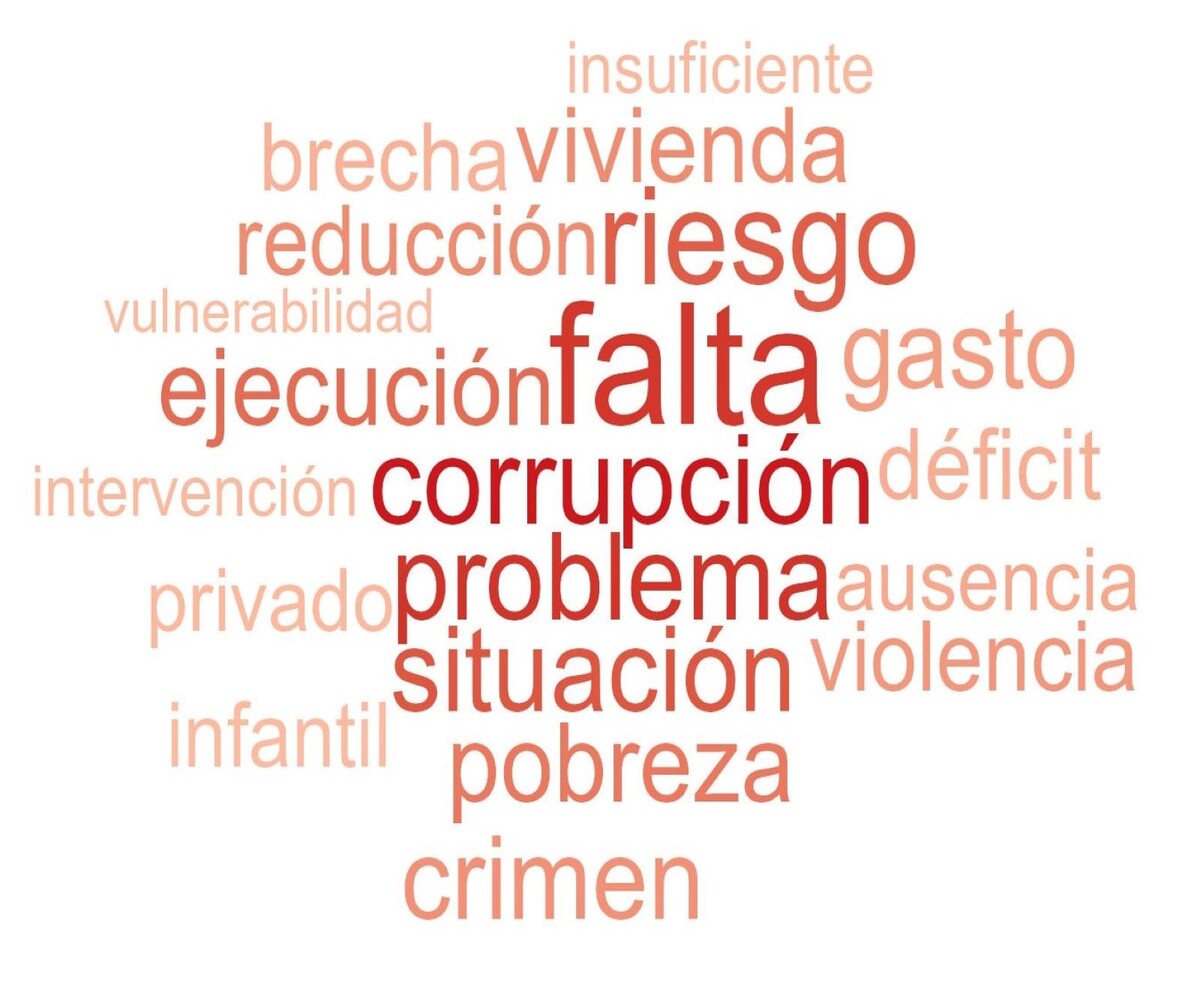
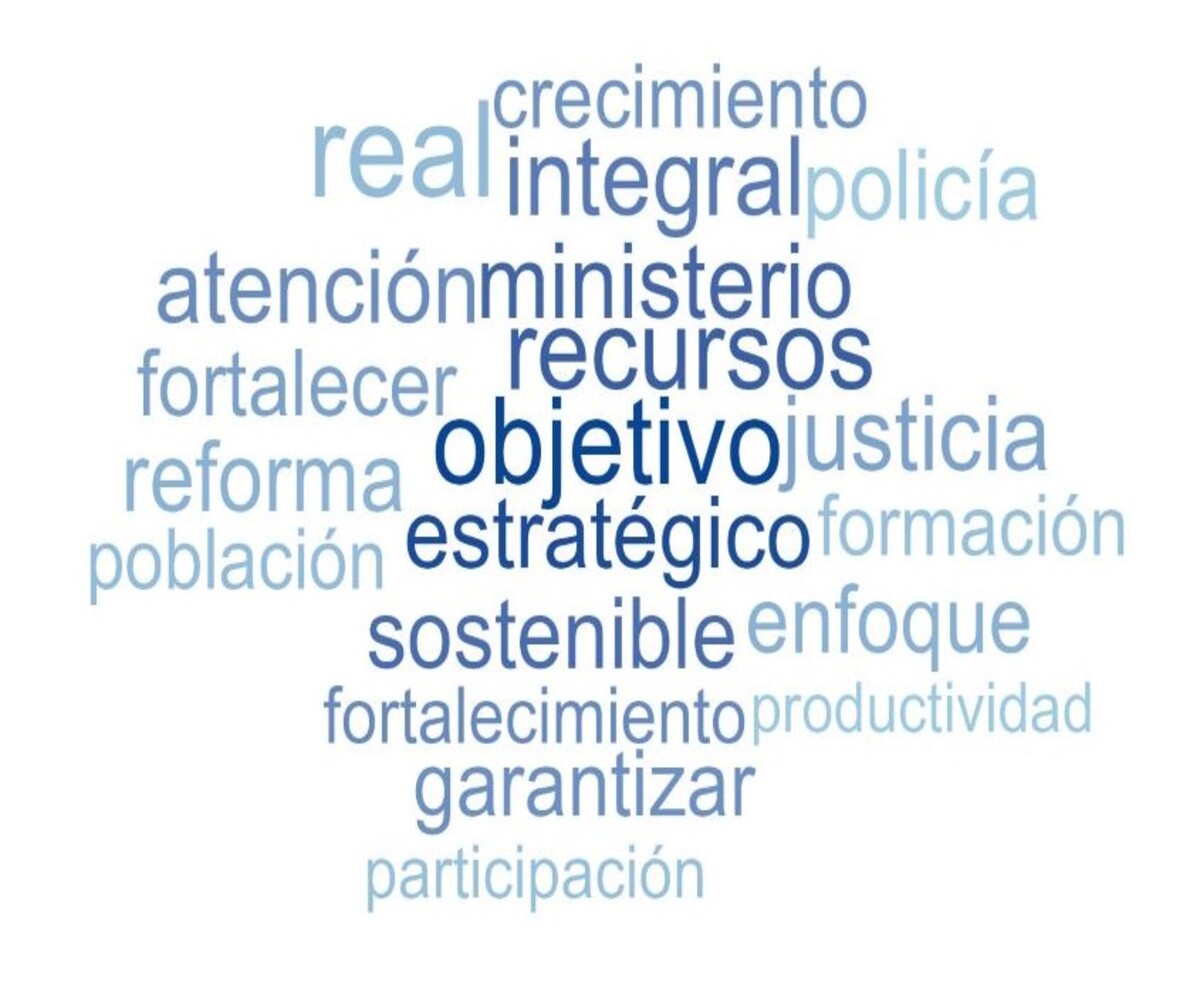
Even within this shared framework, relevant nuances emerge across parties. Fuerza Popular emphasizes infrastructure and access, while País para Todos more strongly introduces concepts linked to employment, investment, and formalization. Meanwhile, Ahora Nación presents a discourse more oriented toward goals and strategic planning, reflected in terms such as objective, target, and strategic.
In contrast, Integridad Democrática stands out for a greater presence of words related to public management, control, and systems, suggesting a more institutionalist positioning. Renovación Popular introduces a clearer language centered on problems, objectives, and indicators, suggesting a narrative more focused on identifying failures and proposing specific corrections. These differences, although subtle, outline distinct conceptions of the role of the state and its priorities.
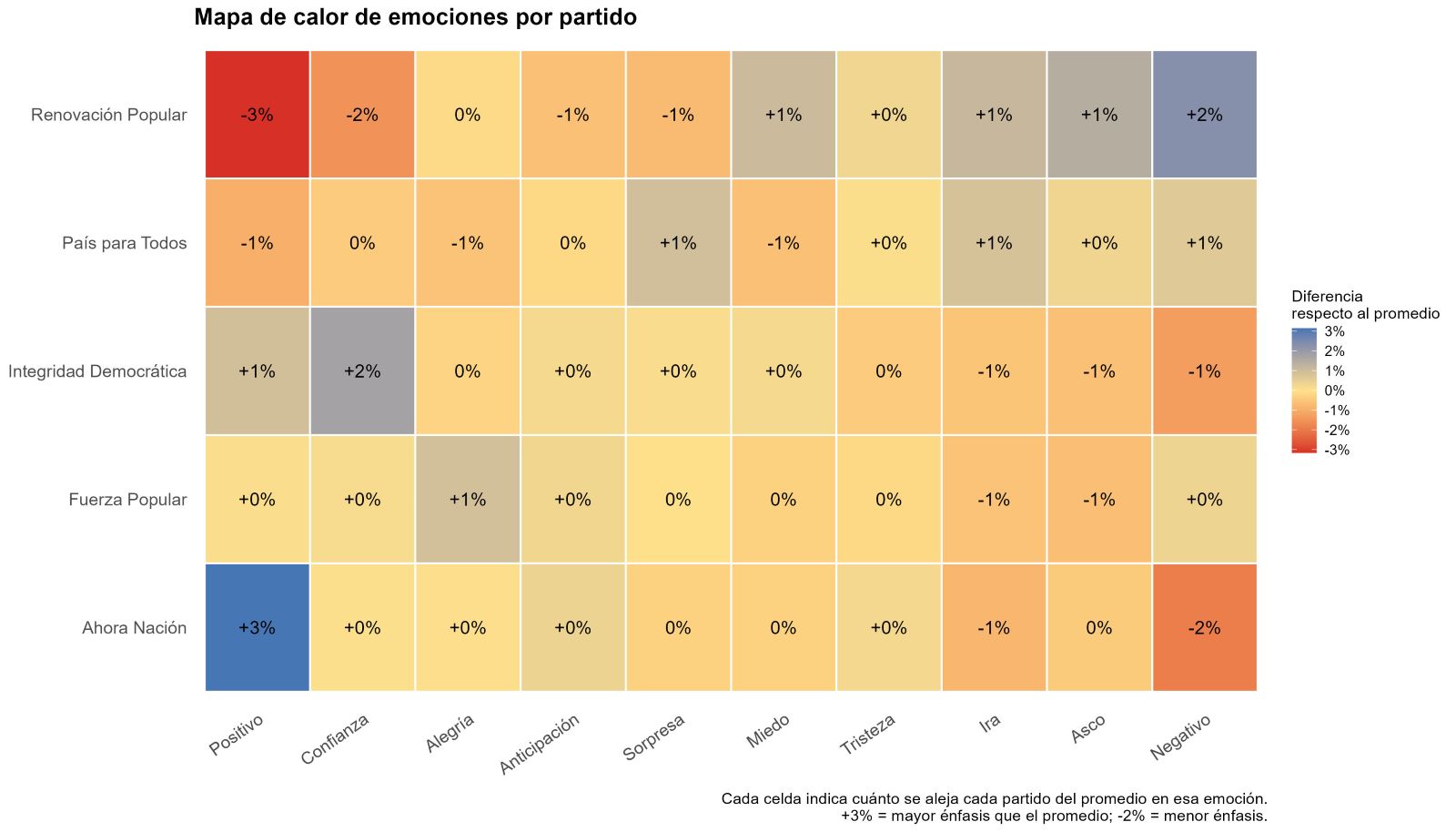
The emotional component of these discourses, measured using the NRC Emotion Lexicon (1), reinforces this interpretation. In all cases, a positive tone predominates, with high levels of trust and anticipation—consistent with the aspirational nature of government plans.
However, there is also a non-negligible presence of negative emotions such as fear and sadness, which serve a clear rhetorical function: diagnosing crisis to justify the need for change and to support voting for a particular political option. This balance between programmatic optimism and critical diagnosis is a common feature in political discourse.
Nonetheless, the intensity of these emotions varies across parties. Renovación Popular presents a higher proportion of negative content compared to the others, suggesting a discursive strategy more centered on problem framing and criticism of the current situation.
At the other extreme, Ahora Nación and Integridad Democrática show the highest levels of relative positivity, which could be interpreted as an attempt to construct a more proactive and less reactive narrative. This difference is significant: emotional tone shapes how voters process information and, ultimately, how they decide their vote.
An evaluation of tone balance—defined as the difference between positive and negative content—allows these dynamics to be summarized more precisely. Ahora Nación leads with the highest positive balance, followed by Integridad Democrática and Fuerza Popular. At the opposite end, Renovación Popular shows the lowest positive balance, reflecting a heavier negative tone in its discourse.
This pattern is not trivial: it suggests that, beyond concrete proposals, there is a contest over emotional framing in the public debate. While some parties center their discourse on hope and future projection, others structure their narrative around crisis as a starting point.
The Citizen’s Challenge
These findings cannot be understood in isolation from Peru’s current political moment. The repeated use of terms such as system, control, and management is not accidental, but reflects a widespread concern: the perception that the state has lost its capacity to organize, coordinate, and respond effectively.
In a country where governability has become fragile and episodic, government plans aim not only to propose policies, but also to reconstruct (at least on paper) an idea of order that has been elusive in practice. In this sense, there is a clear attempt to project control amid the political disorder Peru has experienced over the past decade.
However, this intention collides with an uncomfortable reality: the extreme fragmentation of the political system. With 35 presidential candidates in the race, the 2026 election will not only be competitive, but deeply fragmented.
For voters, this means confronting a saturated political offer, where substantive differences are not always clear and distinguishing between viable proposals and rhetorical promises becomes increasingly difficult. In that vacuum, discourse—tone, word choice, and problem framing—carries more weight than it should.
The problem is that, in the absence of strong parties and consistent programmatic identities, politics risks being reduced to a competition of narratives. Victory does not necessarily go to whoever has the best proposal, but to whoever tells the most compelling story, conveys the most hope, diagnoses the crisis most forcefully, and connects emotionally with a fatigued electorate. While this is not new, in the current Peruvian context its effects may be particularly destabilizing.
For this reason, the challenge of this election is not only political, but also civic. It is not merely about choosing between candidates, but about making the effort to go beyond discourse and assess the real consistency of proposals.
In a scenario where language has become a central tool of competition, distinguishing between form and substance will be key. Ultimately, what is at stake is not only who wins the election, but whether the country can break free from the cycle of instability that has defined its past decade.
Leave a Comment